Introduction

Workshop Description

Caldera-forming volcanism represents one of the most catastrophic geohazards on Earth. Driven by the rapid evacuation of large volumes of magma from the shallow crust, these eruptions form kilometer-scale collapse depressions and are capable of reshaping regional landscapes and altering planetary climate and ecology. Caldera-forming systems at the land–sea interface generate cascading hazards, including tsunamis, seafloor deformation, and atmospheric shockwaves, yet are poorly understood despite their significant socio-economic risks. The Hunga eruption in 2022 underscored this vulnerability, exposing a global lack of preparedness rooted in incomplete understanding of eruption mechanisms, precursory activity and cyclic behavior of marine caldera-forming eruptions. Marine eruptive records, together with greater knowledge of how external factors (e.g., tectonics, sea-level changes, flank collapses) may affect the eruption systematics, are crucial to quantify the hazards of those systems arising for society, economics, and environment.

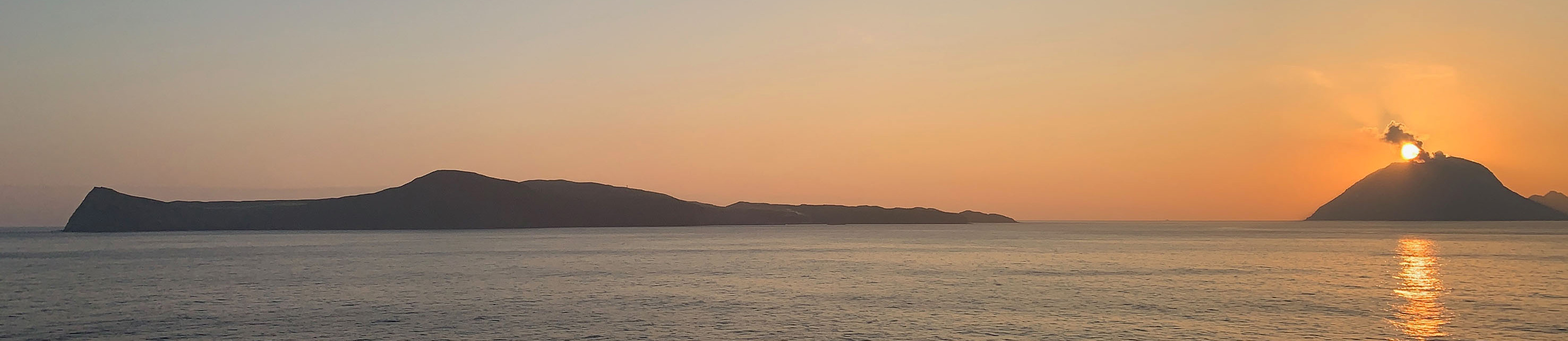
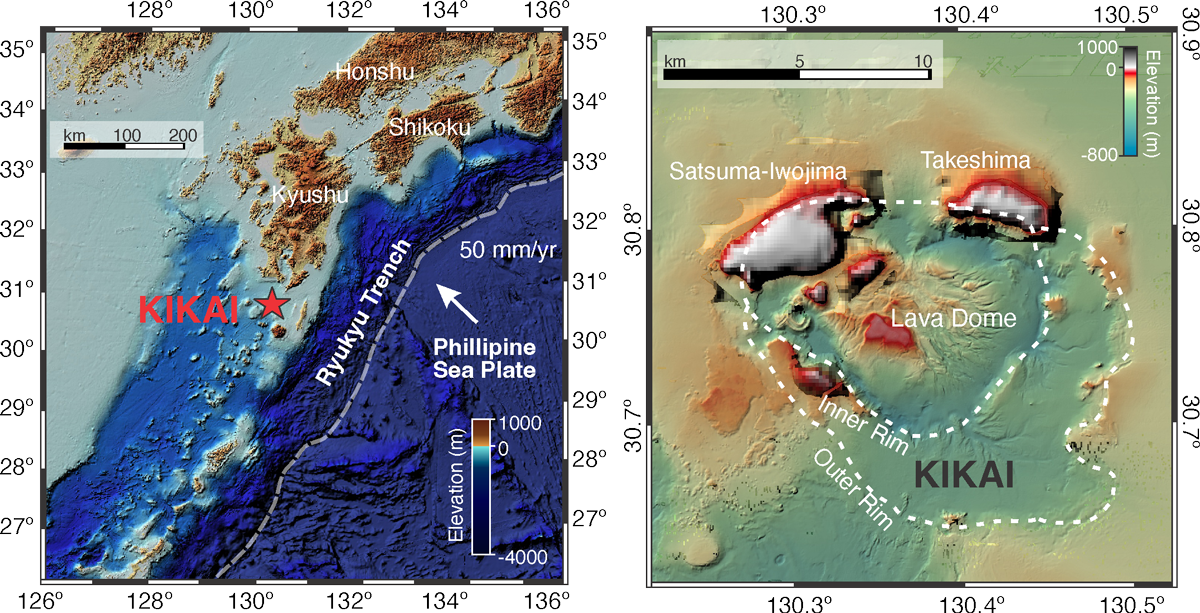
Kikai Caldera, a large, mostly submarine complex located south of Kyushu, Japan, is an ideal natural laboratory to overcome these limitations. Its most recent caldera-forming event, the catastrophic Akahoya eruption at 7.3 ka, was the largest eruption of the Holocene and generated tsunamis and pyroclastic flows traveling over water for >80 km to reach mainland Japan, impacting early Japanese society and culture. Yet because of Kikai’s vast offshore extent, its eruptive history and caldera cycle dynamics, and their relationship to those of other large calderas of Kyushu, are poorly constrained. Obtaining the buried submarine sedimentary and volcanic record at Kikai to establish a robust eruption time series, including eruptive volumes, distribution patterns and geochemistry, and to determine past climate and biological responses, will elucidate the interplay between repeated large eruptions and the ecosystem, paleoclimate and oceanography.

Environmentally, drilling the Kikai caldera-forming eruptions provides a unique possibility to investigate if and how repeated large eruptions and hydrothermalism influence the ability of the ecosystem, and especially the deep biosphere to recover or even benefit from the volcanic eruptions. Similarly, the combined volcanic and sedimentary records offer insight into how paleoclimate and oceanography (e.g. the Kuroshio current) have been modulated or influenced by volcanism in the region.

Developing robust eruption cycle models and accurate assessments of past global atmospheric loading require quantitative and detailed knowledge of eruptive volumes and geochemistry from offshore volcanic deposits and older, buried volcanic sequences that can be recovered only through deep drilling. These considerations prompted us to submit an IODP3 pre-proposal (IODP 1122-Pre, ‘SHREK’, Submarine Hazards, Responses, and Eruption cycles from Kikai caldera).

The main aim of that workshop is to develop an IODP3 full drilling proposal for the R/V Chikyu by elaborating on the scientific hypotheses and questions based on the feedback from SEP on the pre-proposal, identify and modify drilling locations and scenarios, expanding the scientific team and incorporate new expertise, as well as to coordinate future site survey expeditions.
Registration

Registration

Workshop Objectives

Caldera volcanism generates catastrophic geohazards, including tsunamis, seafloor disruption, and widespread ash dispersal, that alter regional landscapes and global climate. Despite extreme socio-economic risks, submarine caldera complexes and their eruption cycles remain poorly understood. The mostly submerged Kikai Caldera (Japan) is the ideal natural laboratory to resolve these blind spots via deep drilling. We hold the SHREK Magellan3 workshop in Kobe, Japan, to advance our active IODP3 pre-proposal (1122-Pre) into a full drilling proposal. The workshop will refine core scientific hypotheses and define optimal drilling targets for the R/V Chikyu.

Scientific Topics

Preliminary working hypotheses identified and which will be discussed during the proposed Magellan3 workshop in Kobe are:

The Kikai volcanic system has grown through multiple Quaternary caldera cycles, involving more frequent large eruptions than currently known, affecting the seafloor and mainland Japan.

The recent lava dome and sediment accumulations within Kikai Caldera record the early inter-caldera stage of the volcanic system and the systematics behind recurrent silicic caldera cycles in coastal volcanic fields.

Caldera-forming volcanism in the extensional Northern Ryukyu region includes progressively increasing caldera sizes modulated by external forces, such as tectonics and climate.

Ash alteration and hydrothermal fluids create redox, nutrient, and metal gradients that structure subseafloor microbial communities and control biogeochemical recovery after large eruptions.
Larger eruptions of Northern Ryukyu arc calderas have modulated and shaped the regional climate and ecology.

Schedule

Programme

Day 1 : 15 March, 2027

9.00 – 11.00 Workshop Introduction (YuzuruYamamoto)
Overview of SHREK and project-related talks 1:
  • SHREK pre-proposal (Steffen Kutterolf)
  • Tectonic overview (Yuzuru Yamamoto)
  • Site survey (Nobi Seama)
  • Onland tephra distribution (Keiko Suzuki)
  • Onland coring (Fukashi Maeno)
Coffee break
11.30-13.00 Continued Overview of SHREK and other related projects
  • Previous coring (Takeshi Hanyu)
  • Dome (Iona Mcintosh)
  • Core-seismic integration - Lessons learned from Santorin and implications for SHREK siteselection (Jonas Preine)
  • Petrology as window into magma chamber processes of cyclic shallow marine caldera systems (Ally Peccia)
  • Physical properties of volcaniclastics and their impact on geophysics and marine geology: (Michael Manga)
Lunch
14.30-16.00 Break-out session plenary - Hypotheses in the scope of SEP reviews:
  1. Review and revisit possible hypothesis
  2. Scientific objectives
  3. Methods and needs
Coffee break
16.30 -18.00 1st Break-out session individual - Hypotheses:
Meeting in different rooms within the identified hypotheses working on the associated scientific objectives and methods
18.30 Icebreaker

Day 2 : 16 March, 2027

9.00 – 10.30 Plenary session:
  1. 1st summary of the individual hypotheses breakout session
Coffee break
11.00-13.00 Project-related talks 2:

Additional scientific talks from both, participants new in the project and that ones already involved, to cover all scientific topics that may be addressed by the Kikai initiative, including introduction of poster presentations

  • Microbiology perspective for caldera area (Yuki Morono)
  • …… (more to come after registration is closed)
Lunch
14.30-16.00 2nd Break-out session individual - Hypotheses:

Meeting in different rooms within the identified hypotheses working on the associated scientific objectives and methods. Possibility to change hypotheses groups

Coffee break
16.30 -18.00 Plenary session:
  1. 2nd summary of the individual hypotheses breakout session
  2. Discussion and feedback

Day 3 : 17 March, 2027

9.00 – 10.30 Operational and technical information:
  1. Chikyu operations: what are the procedures, what is foreseen, what are the limitations
  2. Coring in a volcanic environment: Procedures, lessons and processes established during X398
Coffee break
11.00-13.00 Final break-out sessions – preparation of full proposal:
  1. Pre-site survey data
  2. Site suggestions
  3. Outreach
Lunch
14.30-16.30 Plenary session on SHREK proposals results
  1. Discussion priority list of hypotheses
  2. Assign teams and team leaders for each section for the proposal
  3. Conclusion and end of workshop
Workshop dinner
18.30

Travel grant

Targeted audience is focusing especially on young scientists, complemented by experienced researchers already in the team, with expertise in volcanology, tectonics, core-seismic integration, microbiology, biogeochemistry and paleoclimate. Students and early-career scientists are highly encouraged to attend and will be supported by the workshop funds.

*Attendees who need travel support have to make registration by December31, 2026.

Registration

Registration

Access

Venue

Centennial Hall (Hyakunen Kinen-kan), Rokkoudai 2nd Campus,Kobe University

1-1, Rokkodai-cho, Nada-ku, Kobe, Hyogo 657-8501, JAPAN

Campus maps - Kobe University

From Sannomiya (good place for accommodation) to the venue, there are four steps:

  1. go to Kobe-Sannomiya Station (Hankyu Line),
  2. take a local or a rapid train (do NOT use express service)
  3. get off at the Rokko Station (third station from Sannomiya), the nearest station to the venue.
  4. From the Rokko Station, it takes 10-15 min. walk to the venue.

Accommodation in Kobe

Participants are recommended to stay in Sannomiya. Hotels located within walking distance from Kobe Sannomiya Station (Hankyu Line) is convenient.

Travel to Kobe (Sannomiya)

Most convenient way to Sannomiya would be direct buses from the airports.

Scientific Committee

Yuzuru Yamamoto
Kobe University
Julie Belo
GEOMAR
Steffen Kutterolf
GEOMAR
Fukashi Maeno
University of Tokyo
Jonas Preine
National Oceanography Centre
Yuki Morono
JAMSTEC
Ally Peccia
Columbia University
Keiko Suzuki
Kobe University
Adam Woodhouse
The Open University
Hiroko Sugioka
Kobe University

Flyer

Our flyer is available here.

Organizers

Subsidizers

Local Organizing Committee

Contact

If you have any questions, please use the contact form below.

contact form